LTG
Development of the railway connection Rail Baltica
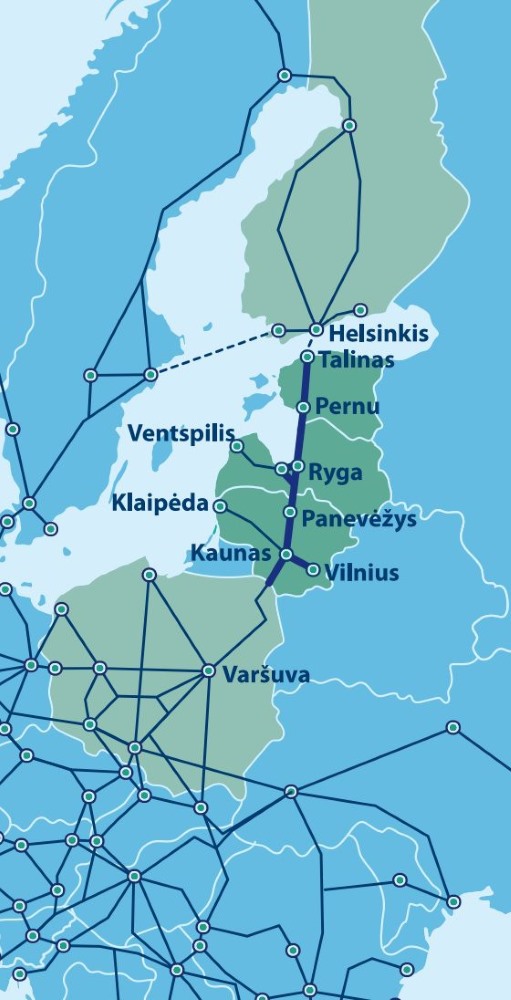
Rail Baltica is a greenfield rail transport infrastructure project with a goal to integrate the Baltic States in the European rail network. The project includes five European Union countries – Poland, Lithuania, Latvia, Estonia and indirectly also Finland. It will connect Helsinki, Tallinn, Pärnu, Riga, Panevežys, Kaunas, Vilnius, Warsaw. The Baltic part of the Rail Baltica project is referred to as the Rail Baltica Global Project.
Environmentally friendly
Rail Baltica will be fully electrified so that any emissions will be avoided. The newest technologies and materials are going to be utilized in its construction. The line is planned so that it avoids the Natura 2000 protected areas as far as possible and without significant impact on other environmentally sensitive protected areas. Wherever necessary, noise protection barriers will be installed. Special animal passages will be built through the embankment.
Safe
Rail Baltica will be built according to the most stringent safety requirements. The newest generation of European railway traffic management system (ERTMS) will be used to control the train movement. All crossings with roads and pedestrian pathways will be at two levels. It will be fenced in full length. Passenger stations will have all the necessary facilities in order to make the access to the train services an easy and pleasant experience to anybody.
Modern
Rail Baltica will be built using the most up-to-date technologies and materials. Some of them are still in the process of elaboration, standardization, or early stages of commercialization. New intermodal freight terminals will be built in each of the Baltic countries to allow for fast and efficient transfer of containerized cargo between different transport modes. Railway stations will represent the latest developments in the area of multimodal passenger terminals connecting conveniently different urban, regional and long-distance services with car and bike parking, shopping and recreative areas.
Facts
- The largest Baltic-region infrastructure project in the last 100 years
- A 10-year construction period
- For both passenger and freight traffic
- Length: 870 km
- Environmentally friendly – powered by electricity, produces less noise and vibration
- Max. speed: 249 km/h (passengers), 120 km/h (freight)
- More than €5 bn investment in the region
- Implemented by Estonia, Latvia, Lithuania
- Part of the EU TEN-T North Sea-Baltic Corridor and Baltic Sea-Black Sea-Aegean Sea Corridor.
- Financed by EU (CEF), Estonia, Latvia, Lithuania
- Provides intermodality/multimodality
- Full interoperability and completing the wider North Sea – Baltic transport corridor by 2030, while working to commence the first operations on some of the sections still by 2028.
Project implementation period: 2016-2030

Installation of a military / civilian loading bay in Palemonas
Project goal: To ensure loading/unloading capacity for civilian-military dual-use in Kaunas Palemonas railway station, and also to create loading and unloading point for general cargo for 1435 mm. railway lines.
Estimated implementation period: 2022-2026

Modernisation of the Railway Level Crossing at Vilnius-Klaipėda Line km 351+780 (Kretinga)
Due to insufficient safety provisions for pedestrians and cyclists at the existing railway level crossing in the town of Kretinga, there is an increased risk of traffic accidents. The crossing currently lacks a safe pedestrian crossing and pedestrian warning signals, while the signalling system, which has been in operation for more than 20 years, no longer meets modern safety standards.
The project includes the modernisation of the railway level crossing at km 351+780 on the Vilnius-Klaipėda railway line (Kretinga) by installing a new pedestrian crossing, an automatic pedestrian signalling system with visual and audible warning signals, a video surveillance system, and other traffic safety measures. Special barriers adapted for people with disabilities will also be installed to reduce the risk of unsafe railway crossing.
Upon completion of the project, safety will be improved for pedestrians, cyclists, road vehicle drivers, and railway traffic. The likelihood of accidents will be reduced, and the railway infrastructure will become safer and more convenient for local residents and visitors to the town.
Project implementation period: 2026-09-28 – 2027-12-31

Electrification of the Kaišiadorys-Klaipėda (Draugystės st.) section
Due to the lack of electrification of the railways, most journeys are made by diesel trains, which are much more polluting than electric trains. The obsolete rolling stock also does not ensure the development of rail as an environmentally friendly transport. The installation of the electric overhead contact line covers the section Kaišiadorys-Klaipėda, Draugystės station (558.6 km of track). The contract works will include the installation of an overhead contact line, new traction substations, and changes to the control systems of the railway stations. The project will improve the infrastructure of the TEN-T network section of transport corridor IX B - state border with Belarus-Kena-Klaipėda (Draugystės station), reduce the use of fossil fuels in the rail transport sector, thus increasing the efficiency of rail transport and reducing environmental pollution.
Project implementation period: 2019–2025
Under the same contract, the electrification of the Vilnius railway junction and the Kaišiadorys-Klaipėda (Draugystės St.) section is being carried out.


Electrification of the Kaišiadorys-Klaipėda (Draugystės st.) section
Phase II
Phase I of the project "Electrification of the Kaišiadorys-Klaipėda (Draugystės St.) Section" is now complete, but the remaining infrastructure management works are necessary to ensure the proper operation of the section. During the implementation of the project “Electrification of the Kaišiadorys-Klaipėda (Draugystės St.) Section. Phase II", the design of the overhead contact network for the electrification of 321 km section is being completed, contract works for the installation of transformers and traction substations are being carried out, and the remaining sections of the Radviliškis-Klaipėda (Draugystės St.) railway line are being electrified. The project will bring the total length of electrified railway tracks in Lithuania to 478.8 km. The electrification of the Kaišiadorys-Klaipėda (Draugystės St.) section will lead to the full electrification of the State border-Kena-Klaipėda section of the trans-European transport network. The entire State border-Kena-Klaipėda (Draugystės St.) section will be open for operations using electric traction. Electrification of the Kaišiadorys-Klaipėda section will also help to reduce air pollution in the municipalities of Kaišiadorys, Klaipėda, Jonava, Kėdainiai, Radviliškis, Šiauliai, Telšiai, Plungė and Kretinga. Upon completion of the project, the project objectives will be achieved: the railway infrastructure of the section Kaišiadorys–Klaipėda (Draugystės St.), which is part of the Trans-European Transport Network, will be modernized and adapted for electric traction train operations. This will create conditions for reducing the use of fossil fuels in the railway transport sector, increasing the efficiency of railway operations, and decreasing the negative impact on the environment. The project will also contribute to the intended objective of increasing the EU-compliant share of the core network of the trans-European transport network from 7% in 2016 to 100% in 2030.
Project implementation period: 2025-2026


Vilnius Railway Node Electrification
Due to the lack of electrification of the railways, most journeys are made on diesel trains, which are much more polluting than electric trains. The obsolete rolling stock also does not ensure the development of rail as an environmentally friendly transport. The installation of the electric overhead contact line covers the Kyviškės-Valčiūnai-Vaidotai-Paneriai and Vilnius-Kirtimai-Valčiūnai sections (114 km of track). The works will include the installation of an overhead contact line, new traction substations, and changes to the control systems of railway stations. The project will divert freight train traffic away from the centre of Vilnius to the ring road, reducing noise and congestion caused by parking at the level crossing and improving traffic safety. The project will also improve the infrastructure of the TEN-T network section of transport corridor IX B - the state border with Belarus-Kena-Klaipėda (Draugystės St.), reduce the use of fossil fuels in the rail transport sector, which will increase the efficiency of rail transport and reduce environmental pollution.
Project implementation period: 2019–2025
Under the same contract, the electrification of the Vilnius railway junction and the Kaišiadorys-Klaipėda (Draugystės St.) section is being carried out.

Modernisation of priority level crossings on the Vilnius-Klaipėda line
During the modernization of the ten priority level crossings of the Vilnius-Klaipėda line, measures such as signaling and related equipment, train locating equipment, safety/fire alarm, obstacle detection system, road condition determination system, video surveillance system, etc. will be installed. The project aims to ensure the safe traffic of trains, cars and pedestrians, and the implemented measures will help to ensure proper monitoring of the crossings and protection against pedestrians and vehicles entering the crossings when the train is approaching.
Project implementation period: 2020-2026

Installation of private electric vehicle charging points at workplaces of legal entities
The opportunity to receive support from the joint project "Installation of private electric vehicle charging points" by submitting an application to the Lithuanian Energy Agency in accordance with the published call "Installation of private electric vehicle charging points at workplaces of legal entities" prompted LTG and LTG Infra to plan the installation of electric vehicle charging points.
A total of 16 stations with 32 access points were installed with the support of the grant. The access points were installed at company-owned facilities in Vilnius (18 access points), Kaunas (4 access points), Šiauliai (6 access points), and Klaipėda (4 access points).
The project is being implemented under the economic recovery and resilience plan "New Generation Lithuania," financed by the European Union's economic recovery and resilience measure "NextGenerationEU."
Project implementation period: 2025